
Comprehensive training and certificate programs in contemplative care for laypeople, caregivers, counselors, and future chaplains. The program integrates contemplative praxis with ethical, cultural, historical, and psychological perspectives—preparing practitioners to serve skillfully in diverse settings.
Fostering the Future of Contemplative Care
The Buddhist Chaplaincy Training provides core resources and skills for Buddhist-based chaplaincy and contemplative care.
Chaplaincy is a growing profession with the need for chaplains outpacing numbers of chaplains available. However chaplaincy training in the United States has largely taken place in a seminary model focused on Christian traditions and scriptures. This leaves a large gap in available chaplain care for people who live and die outside Christian paradigms. BSI’s Buddhist Spiritual Care Certificate fills this gap, offering a certificate program to provide the array of resources and skills needed to serve as a Buddhist Chaplain are chaplaincy service provider.
Likewise, there has been a growing integration of Buddhist techniques into health care settings based on mindfulness meditation and other techniques. The Buddhist Chaplaincy certificate fills the gap left by these extractive trainings by connecting contemplative praxis and teaching with its vital historical, ethical, philosophical, and cultural elements.
This robust training also provides an array of the essential training necessary to serve as an ethical leader in contemporary times, elements missing from traditional Buddhist teacher trainings such as boundary setting, empathy skills, updated understanding of sexual ethics, and Tibetan Buddhist perspectives on trauma -informed care.
The Buddhist Chaplaincy Certificate provides knowledge, skills, and resources for care in a variety of settings, with a specialization in Buddhist hospice chaplaincy.
The training is open to those who wish to serve as chaplains and those who wish to explore compassionate care from a Buddhist perspective. See prerequisites below.
This program welcomes non-Buddhists and Buddhists from all denominations yet also presents Buddhist spiritual care from the Vajrayana perspective, based on the Tibetan Buddhist Tradition.
The Buddhist Chaplaincy Certificate is a program for those who wish to pursue Board Certified Chaplaincy. It is geared towards satisfying the following components of Board Certified Chaplaincy to demonstrate competency in:
- Spiritual care in terms of the chaplain’s own spiritual tradition
- History of a religious or philosophical tradition
- Spiritual Practices or Practical Ministry
- Training in ritual, ceremonial and liturgical practice
- Sacred Texts or Foundational Documents
- Understand Buddhist theories of spiritual care
- Be able to analyze the strengths and limitations of their own spiritual tradition
- Hold academic perspectives of religion and spirituality from historical, psychological and sociological point of view
- Understand at least one ethical framework and its application in Chaplaincy settings
- Developed cultural humility and capacity to honor others self-understanding
- History of Buddhist Contemplative Praxis
- Contemplative Care skills
- Faith group endorsement or recognition
In addition to Religious Competency described above to become a board certified chaplain through the Association of Professional Chaplains, the requirements also include:
1. Master’s degree or application for equivalence through 7200 hours of mentored study in a Buddhist tradition
2. CPE – Clincal Pastoral Education, two units for Associate Certified Chaplains and 4 units for Board Certified Chaplains
3. Work Experience
4. Professional Competence

About the Buddhist Studies Institute
The Buddhist Studies Institute provides comprehensive online training in Buddhist philosophy, meditation, and contemplative care from the scholar-practitioner’s perspective. We address a critical gap in American spiritual care by offering authentic Buddhist formation for teachers, caregivers, and chaplains. Our programs bridge traditional Vajrayana wisdom with modern trauma-informed, ethical, and culturally responsive practices, preparing practitioners to bring compassion, mindfulness, and insight into healthcare, hospice, education, and community settings.
Program Goals
The Buddhist Chaplaincy Training at BSI provides professional-level Buddhist formation and contemplative care skills through five certificate programs that culminate in Buddhist Spiritual Care Certification. The program:
- Provides the Buddhist-specific religious training and ordination pathways missing from seminary programs.
- Develops competence in contemplative care, trauma-informed practice, and ethical leadership.
- Prepares students for board certification eligibility through accredited university and CPE programs.
- Democratizes access to authentic Buddhist training through an accessible online platform that serves caregivers, professionals, and practitioners worldwide.


Meditation Teacher Training
This program establishes a strong foundation in Buddhist contemplative practice and pedagogy. Students learn how to teach meditation in diverse contexts while cultivating ethical awareness and inclusivity.
- Instruction in Buddhist meditation techniques and teaching methods
- Guidance on teaching in multicultural and interfaith settings
- Training in inclusive, accessible pedagogy
- Mentored practicums with feedback for skill development
- Preparation to support communities with integrity and clarity

Buddhist Psychology
This program introduces core Buddhist perspectives on mind, suffering, and transformation, in dialogue with Western psychology. It offers a comprehensive study of inner life and the cultivation of resilience.
- Exploration of the Four Noble Truths and frameworks of suffering/stress
- Study of interdependence and tantric models of identity
- Intensive dialogue with Buddhist and Western psychological approaches
- Practices for transforming suffering through Sutrayana and Bodhisattva paths
- Tonglen training, book studies, and integration of mindfulness in therapy

Advanced Meditation Teacher Training
Building on foundational training, this program deepens methods for transforming afflictive states and teaching advanced meditation. Emphasis is placed on resilience, empathy, and compassionate leadership.
- Sutrayana and Vajrayana approaches to transforming suffering
- Tonglen intensive with supervised internship practice hours
- Training in empathy skills, common challenges, and resilience building
- Strategies to avoid compassion fatigue and empathetic distress
- Preparation for guiding others in difficult or crisis contexts

Buddhist Hospice Training
This program prepares caregivers to serve people at the most profound threshold of life—illness, dying, and death—through Buddhist perspectives and rituals.
- Training in Buddhist rituals for illness, dying, death, and post-death care
- Guidance in caring for the body and spirit after death according to tradition
- Study of bardo teachings and Tibetan Buddhist end-of-life practices
- Supervised hospice practicum with direct experience
- Guest teachers offering practical and ceremonial expertise

Buddhist Spiritual Care
This capstone program integrates the previous certificates and provides direct chaplaincy experience. Students complete supervised internships while refining pastoral skills and demonstrating competency.
- Compassionate Care Intensive focused on presence and resilience
- Training in pastoral and contemplative care in chaplaincy contexts
- Skill development with guest chaplain instructors
- Guided volunteer internship (40+ supervised hours)
- Completion of final project, exam, and certification requirements
Leadership Practicum Requirement
Advanced training includes a mentored leadership practicum, which may be fulfilled through serving as a Teaching Assistant in the Meditation Teacher Training or through approved continuing education and service pathways.
The program culminates in the Buddhist Spiritual Care Certification, providing comprehensive Buddhist-based chaplaincy training. Graduates will still need to complete accredited university and CPE requirements to be eligible for Board Certification. Our program offers a strong preparatory foundation, emphasizing competencies in Buddhist contemplative care that complement and enhance academic chaplaincy training.
Faculty
Led by Tulku Pema Khandro, PhD
with BSI Faculty, Guest Chaplains, Hospice Specialists, and Psychologists
The Lineage Holder and Teacher
Tulku Pema Khandro, Ph.D.
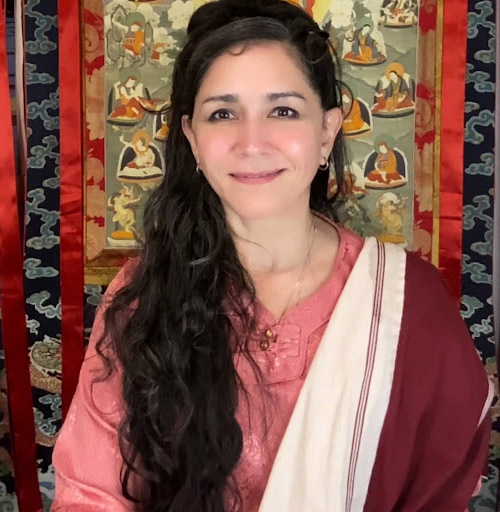
Tulku Pema Khandro, Ph.D is an internationally renowned teacher and scholar of Buddhist philosophy. She is the founder of Ngakpa International and its three projects, The Buddhist Studies Institute, Dakini Mountain, and the Yogic Medicine Institute. In her work as a Buddhist teacher, she is an authorized Lama and lineage holder of the Nyingma and Kagyu traditions and was enthroned to carry on the lineage of her predecessor, the first Pema Khandro, an early twentieth-century yogini from Eastern Tibet, whose primary practices were Dzogchen and Chod.
Pema Khandro has led a vibrant worldwide community since 1999. Through the Buddhist Studies Institute, she also offers a complete curriculum of training in Tibetan meditation and Buddhist Philosophy. She has a bachelor’s degree in Sociology, a Master’s degree specializing in Tibetan studies, and a Ph.D. in Buddhist Studies from the University of Virginia. Today she is a Professor of Buddhist studies. Her scholarly research focuses on the history of Dzogchen and on Women in Tibetan Buddhism.
Buddhist Studies Institute Faculty

Aruna Rig’dzin Ross was ordained in the Nyingma lineage by Pema Khandro in 2007 and has since dedicated her life to the study, practice, and transmission of Buddhist wisdom. She serves as a Director of Ngakpa International, is the Chief Financial Officer of the Buddhist Studies Institute, and also leads as Director of the Yogic Medicine Institute, where she integrates ancient wisdom traditions with modern approaches to healing and well-being.
A NAMA-certified Ayurvedic Practitioner with more than two decades of experience as an advanced yoga and meditation instructor, Aruna is deeply respected for the clarity, compassion, and presence she brings to her work. Her teachings and client care reflect a passionate commitment to holistic healing, sustainable living, and the empowerment of individuals to cultivate health, balance, and joy in their lives.
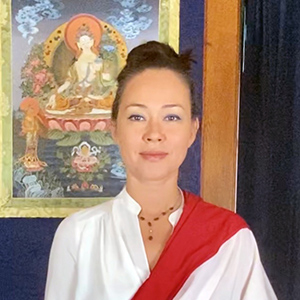
Dr. Satya Shiva has been a devoted student of Pema Khandro and the Vajrayana since 2001 and has served as Faculty, Programming Director, and board member of the Buddhist Studies Institute since 2010. She is also the Clinic Director of the Yogic Medicine Institute, where she has guided integrative healing programs and worldwide retreats since 2004.
A Doctor of Acupuncture and Oriental Medicine, as well as a NAMA-certified Ayurvedic Practitioner and Panchakarma Specialist, Satya is the founder of Radiance Healthcare and Clinical Director at Dakini Mountain Retreat. Her leadership reflects a lifelong dedication to Eastern medicine, integrative healing, contemplative practice, and compassionate care, guiding people toward radiant health, clarity, and vitality.
FAQ – Frequently Asked Questions
Is this a Full Chaplaincy Program?
No. It is a supplementary Buddhist Spiritual Care pathway that supports competencies often required for board certification and can complement accredited clinical training (e.g., CPE).
Do I need to be Buddhist?
No. The program welcomes non-Buddhists, while presenting spiritual care from the Vajrayana perspective.
Will Sessions Be Recorded?
Sessions are recorded and typically available within 24 hours of the live class online. Recordings are available for 2 years.
Will my previous training count?
Selected prior training (e.g., previous MTT completions) may apply; submit certificates/syllabi for review.
How do practicums/internships work?
Supervised hours are completed with approved sites or online contexts, with faculty oversight, reflective writing, and skill assessments.
Who Should Apply
- Aspiring chaplains from all Buddhist traditions (and open to non-Buddhists in contemplative care)
- Hospice, hospital, and community caregivers seeking spiritual care training
- Buddhist teachers looking to strengthen formal care and ethics skills
- Healthcare and mental health professionals integrating contemplative practice
Prerequisites
- A consistent meditation practice, or commitment to establish one
- Ability to engage in reflective writing and self-assessment
- Readiness for supervised practicum and feedback-based learning
- Comfort working in trauma-sensitive and end-of-life contexts
Format
- Combination of live online classes with experienced faculty
- Self-paced study materials to support flexible schedules
- Supervised practicums offering guided, hands-on experience
- Community learning environment with peer support and dialogue
Assessment
- Weekly class sessions with module-specific practicums/internships
- Teaching demonstrations and skill-based exercises
- Reflective writing and supervised practice hours
- Capstone project and final assessments for certification
Tuition and Member Pricing
Each Core Training Domain may be taken individually or as part of the full Buddhist Spiritual Care Certification.
- General Tuition: $12,500 for the complete certification (five certificates)
BSI member discounts apply toward advanced training and chaplaincy pathways.
- Sustainer Member: 40% off
- Snow Lion Members: 25% off
Complete Program Bundle
Certification in Buddhist Spiritual Care
- Buddhist Spiritual Care Certification
- Full Buddhist Chaplaincy Prep (All Five Domains)
- General Tuition: $12,500
- Snow Lion Member Tuition: $9,375
- Sustainer Member Tuition: $7,500
Individual Certificates
- Meditation Teacher Training
- Jan 26 – July 27, 2026
- Buddhist Psychology Training
- 2026-27 Dates TBA
- Advanced Meditation Training
- 2026-27 Dates TBA
- Buddhist Hospice Care Training
- 2026-27 Dates TBA
Forthcoming Training programs will follow the weekly meeting rhythm and curricular style of the Meditation Teacher Training.