Where does wisdom actually abide? Not as a metaphor, not as an aspiration, but as a reality — where is it, how does it dwell there, and how do we distinguish it from what it is not?
In the Fourth Vajra Topic of the Treasury of Words and Meanings, Longchenpa takes up one of the most consequential and most misunderstood questions in all of Buddhist thought: the actual location and manner of abiding of wisdom awareness (ye shes). This is the question that separates genuine understanding of the Dzogchen view from vague approximations of it — and Longchenpa addresses it with a level of precision that is unmatched in the tradition.
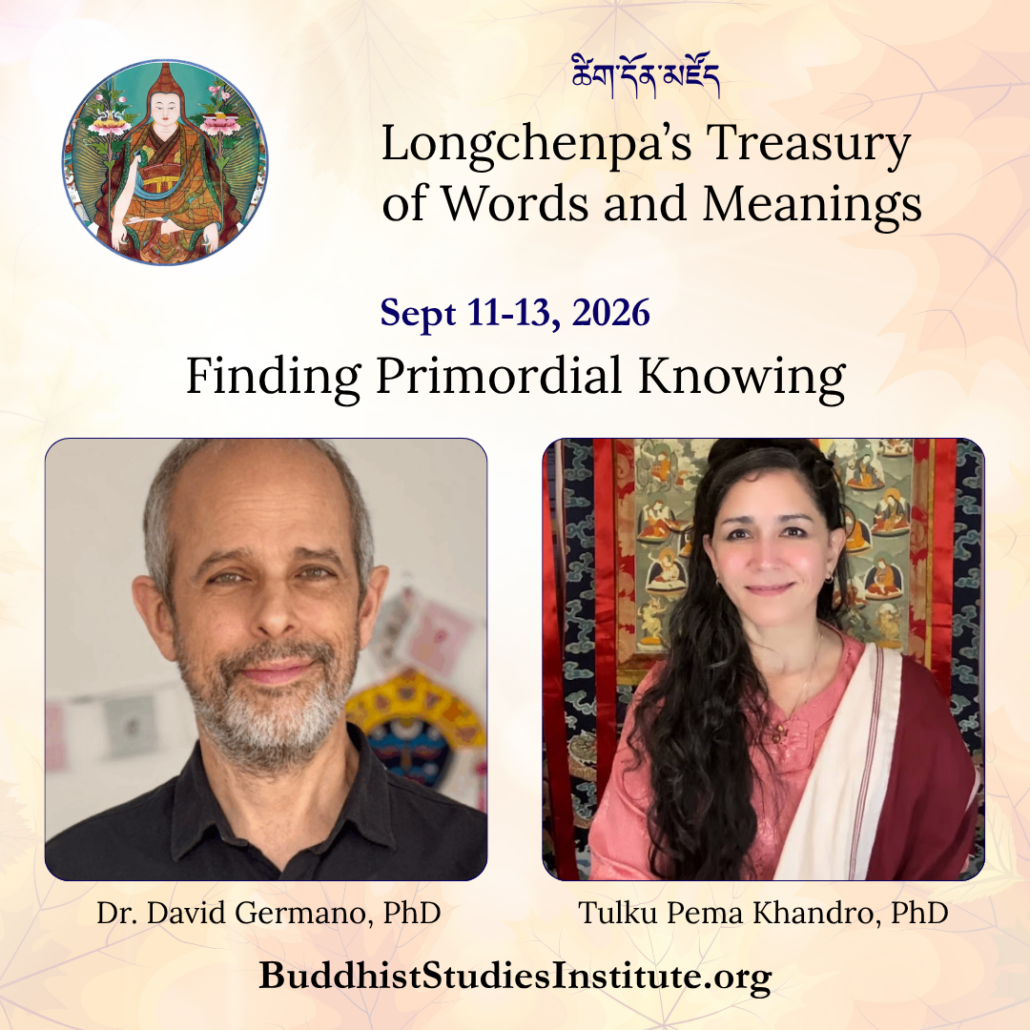
This three-day weekend program, hosted by Dr. Pema Khandro and led by Dr. David Germano, will offer a careful guided reading through the heart of this chapter. We will begin with Longchenpa’s general account of where wisdom abides and how it dwells, illuminated by the vivid analogies he draws to make the inconceivable graspable. From there we enter what Longchenpa calls “the King of the Supreme Secret” — the specific and extraordinarily subtle distinctions that most practitioners never fully clarify. Chief among these are two sets of key points that are essential to authentic Dzogchen understanding: the distinction between ālaya and dharmakāya, and the distinction between mind (sems) and wisdom (ye shes). These are not academic technicalities. They are the fault lines where confusion and realization diverge. To mistake ālaya for dharmakāya, or to confuse ordinary mind with wisdom, is to build one’s entire practice on a misidentification — and Longchenpa knew this. He devotes sustained attention to the distinguishing features of each, working through both the common classifications found across Buddhist philosophical traditions and the specific, definitive tradition of the Great Secret unique to Dzogchen.
Longchenpa himself signals the difficulty and importance of this material: these are “difficult-to-understand topics concerning mind” and “difficult-to-realize topics concerning wisdom.” They are difficult precisely because they concern distinctions that cannot be grasped by the very mind one is trying to see beyond. Yet they must be clarified — intellectually, contemplatively, and experientially — if the Dzogchen view is to become anything more than a beautiful idea. This weekend is a rare opportunity to work through these distinctions with the care and depth they demand, guided by Dr. David Germano, one of the foremost scholars of Longchenpa’s writings in the world, and Tulku Pema Khandro, Ph.D., whose integration of scholarly rigor and living lineage transmission brings these teachings fully alive.”