Program Three of the Yogini’s Teachings
Online
Online via Zoom
with recordings provided for all sessions
Online via Zoom
with recordings provided for all sessions
Sat–Sun, November 7–8, 2026
9am-1pm PT
November 9, 16, 23, 30
5pm-6:30pm PT
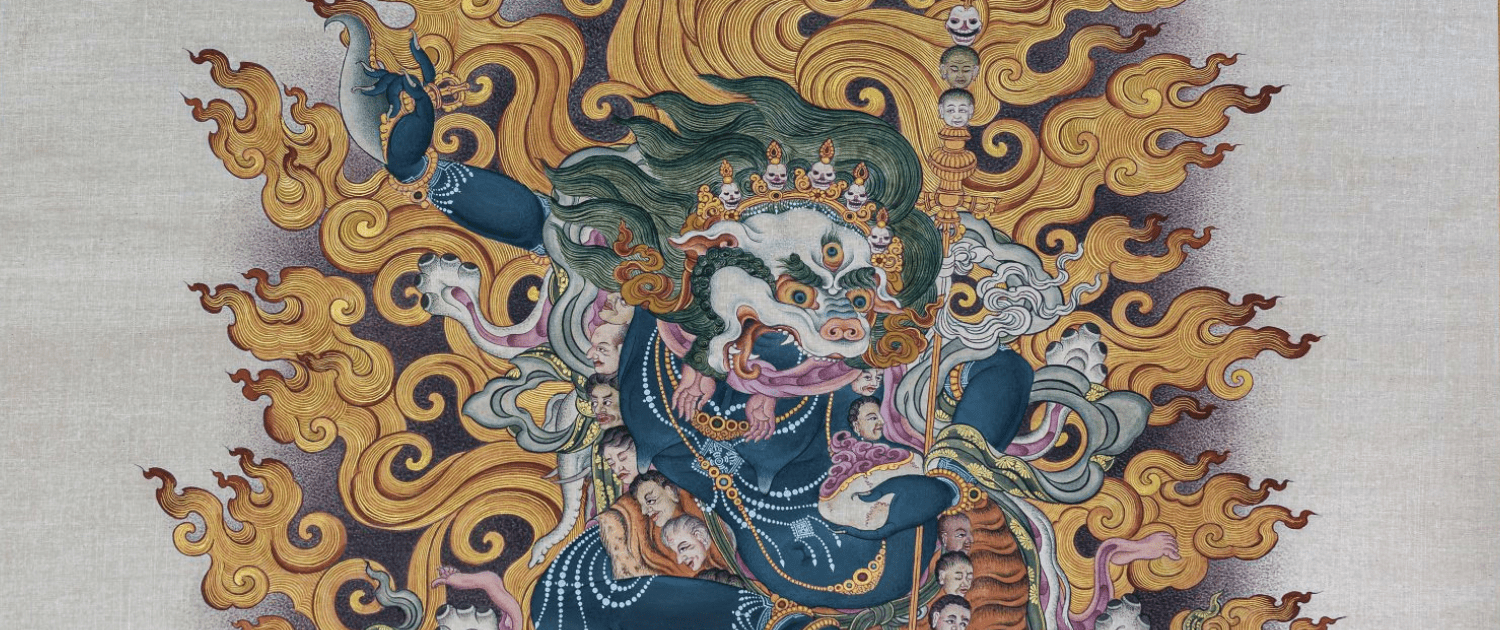
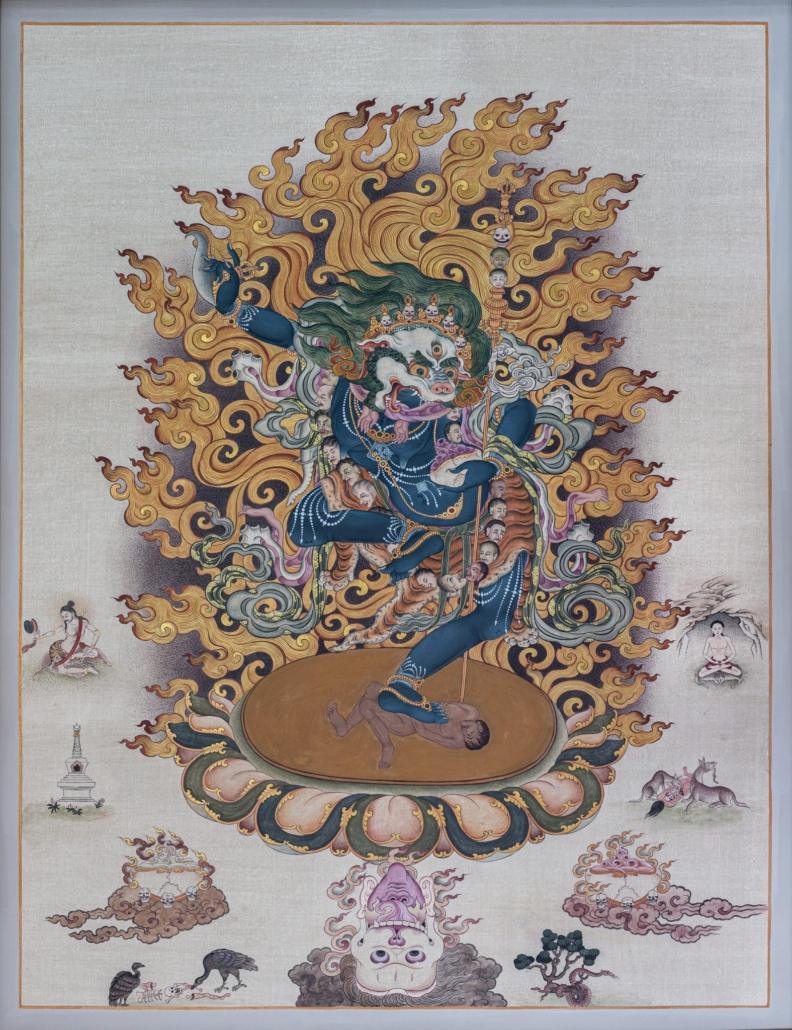
Simhamukhā is often called the fiercest protector in Tibetan Buddhism. Where White Tara sustains life and Vajrayogini transforms its raw energies into bliss, the Lion Faced Ḍākinī’s role in the tradition is more specific and, for those who need her, indispensable. She is the yidam practitioners turn to when the obstacles are severe, when the negativity feels overwhelming, when subtle patterns of self-grasping have proved resistant to gentler methods, and when the practitioner needs the direct cutting power of wrathful wisdom.
Her practice is engaged for the removal of obstacles, both outer and inner. Practitioners engage her when facing serious illness, when navigating hostile circumstances, when experiencing what the tradition calls interference from subtle forces that disrupt life and practice, and when the ordinary methods of purification and pacification have not been sufficient. Her mantra, the very mantra Padmasambhava himself used to defeat the non-Buddhist opponents in Uddiyana, carries the specific power of the protector who cuts through what cannot be persuaded, negotiated with, or bypassed.
What practitioners describe finding in her practice is a particular quality of presence that is difficult to name and unmistakable once encountered. The wrathful face of the sacred feminine is not opposed to compassion in the tradition’s understanding. It is compassion, in its most decisive and uncompromising form. Practitioners speak of feeling accompanied in dark times, of finding courage where they did not expect it, of watching subtle patterns of harm and delusion dissolve in her practice that had held firm through years of gentler methods. The tradition calls this the fierce grace of the ḍākinī, and it is Lion-Faced Ḍākinī’s particular gift.
She is invoked at moments of threshold and difficulty. Practitioners engage her practice at the beginning of retreats, so obstacles do not derail the work. They engage her at moments of illness and crisis, when protection is needed most. They engage her in emergencies, since her practice is one of the traditional supports for averting and facing crisis. And they engage her as an ongoing companion of dharma practice: the fierce presence that watches over the whole life of the path.
Practitioners who have received her transmission often describe feeling, from that day forward, a sense of being accompanied, protected, and covered by a presence that had not been present in the same way before.
The Lion-Faced Ḍākinī Retreat and Program is the closing program of The Yoginī’s Teachings fall series and the wrathful face of the sacred feminine through the Great Perfection tradition. In Sanskrit she is called Simhamukhā, in Tibetan, Senge Dongma, both refer to the Lion-Faced Ḍākinī. She is a wisdom ḍākinī of the Dzogchen tradition, traditionally understood as the secret wrathful form of Guru Padmasambhava himself and, within the Longchen Nyingthig, as the wrathful and secret aspect of Yumka Dechen Gyalmo, the Female Practice of the cycle.
In the Longchen Nyingthig specifically, the Lion-Faced Ḍākinī holds a role of elevated significance. Her lineage in the Longchen Nyingthig was revealed by Jigme Lingpa as a mind treasure, drawn from the transmission that Padmasambhava gave to Yeshe Tsogyal in the eighth century.
The lung, or oral transmission given here by Tulku Pema Khandro is from the Longchen Nyingthig lineage, connecting students directly to the transmission of one of the most powerful ḍākinīs in Tibetan Buddhism.
Her practice is traditionally associated with removing obstacles, averting negative influences, protection from curses, and cutting through the deepest layers of delusion.
The program continues with four Monday evening sessions on the wisdom ḍākinī within the Great Perfection tradition: Pemasel and the origins of Dzogchen, the Khandro Nyingthig and Yumka Dechen Gyalmo as the Female Practice, Jetsun Lochen Chönyi and the female lineage of Simhamukhā, and a closing session on the meaning of the sacred feminine at the culmination of the Nyingma path.
This program is complete in itself and open to all who wish to receive this transmission. No prior events are required. It is also the closing event of the Yoginī’s Teaching programs with Pema Khandro, which also gathers three faces of the sacred feminine (peaceful, semi-wrathful, wrathful) as they appear in a single treasure cycle across the fall arc.
November 7–8, 2026
To receive the lung, the oral transmission, is to be placed inside the living stream of the lineage. In the Tibetan tradition, the mantra is not something a practitioner learns from a book. It is something that is transmitted, voice to voice, teacher to student, in an unbroken chain that runs from Padmasambhava himself through Yeshe Tsogyal to Jigme Lingpa and forward through every holder of the Longchen Nyingthig into the present moment. The lung is the sound of that chain arriving at you. When you receive it, you are not learning a new mantra. You are being joined to a current of blessing that has moved through the voice of every practitioner who has ever held this lineage, and the mantra you take up afterward is a mantra that already carries their realization inside it.
Practitioners describe the difference this makes as unmistakable. A mantra recited without transmission is a syllable. A mantra recited after transmission carries the blessing power of the lineage. The recitation carries a quality of presence, protection, and blessing that practitioners describe as tangibly different from the same syllables recited without the lung. This is why the tradition has been so careful, across twelve hundred years, to preserve the oral transmission alongside the written texts. The written text preserves the words. The lung preserves the wisdom and the power.
The Lion-Faced Ḍākinī occupies a distinct position in the Nyingma tradition. She is understood as a secret form of Padmasambhava himself, manifested to avert spiritual obstacles and negativity. Her mantra is the mantra Padmasambhava used to defeat non-Buddhist opponents in Uddiyana. She is one of a group of female deities that appear in the Bardo Thödol, the so called Tibetan Book of the Dead.
Within the Longchen Nyingthig, she holds a doubly important role. She is the wrathful and secret aspect of the Female Practice, Yumka Dechen Gyalmo: the fully wrathful expression of what Yumka expresses in peaceful and semi-wrathful modes. And she is the principal guardian of the entire Longchen Nyingthig cycle: the protector of the whole treasure revelation of Jigme Lingpa. To take up her practice within the Longchen Nyingthig is to enter both the wrathful face of the sacred feminine and the protection of one’s mind from being assailed by afflictions.
The two-day weekend combines empowerment ceremony with teaching on the Lion-Faced Ḍākinī’s iconography, her place within the Longchen Nyingthig cycle, her lineage of transmission from Padmasambhava through Yeshe Tsogyal to Jigme Lingpa and into the present, and detailed practice instruction. Students will complete the retreat prepared to take up the practice.
The Four Monday Evening Sessions:
Most Tibetan Buddhist lineages begin with a male master. The Heart Essence of the Ḍākinī, one of the most important Dzogchen cycles, begins with an eighth-century girl, Padmasambhava’s disciple, and daughter of King Trisong Detsen. Her death became the seed of the lineage: Padmasambhava revealed teachings to her that would emerge, across her successive rebirths over the following six centuries, as one of the cycles that ultimately shaped Longchenpa’s Great Perfection (Dzogchen) teachings. We read selections from her life-story, translated from Tibetan for this course, and trace the thread of a single yoginī’s lineage across a thousand years exploring themes of women’s lives, consorts, and treasure revelation in esoteric Buddhism
At the heart of the Heart Essence of the Ḍākinī, lies one of the most remarkable texts in all of Tibetan Buddhist literature: the interview between Padmasambhava and Yeshe Tsogyal on the view of the Great Perfection. In this text, Yeshe Tsogyal is not the disciple who receives passively. She is the questioner. She presses Padmasambhava with the difficult questions about the nature of mind, the meaning of primordial purity, the relationship of appearance and emptiness, and the way the Dzogchen view is to be recognized in direct experience. He answers. She questions further. The conversation moves through the whole architecture of the Great Perfection.
This week we read the interview closely, drawing on Pema Khandro’s own scholarly work on the three fourteenth-century transmissions of this text. We attend to what the conversation reveals: about the Dzogchen view itself, about Yeshe Tsogyal’s function within the lineage as the one who asked the questions that opened the tradition’s most subtle teachings, and about the ancestral form of student-teacher exchange that shaped the entire Nyingthig transmission. Practitioners will come away with a direct encounter with the Dzogchen view as Padmasambhava himself articulated it, alongside a new appreciation for the female voice that drew it out of him.
Meet Shukseb Jetsun Lochen Chönyi Zangmo (1865–1951), the Tibetan female lama widely recognized as one of the most important yoginīs of the twentieth century, held to be an incarnation of Machig Labdrön and an emanation of Yeshe Tsogyal. Abbess of Shukseb Nunnery, master of Chöd and of the Nyingthig transmission, and a lineage holder of Simhamukhā practice. Her life and practice give us the female presence in the wrathful and Dzogchen tradition at the modern edge of the lineage we have been studying.
The closing session of The Yoginī’s Teachings. We gather what has emerged across the whole arc: the peaceful sacred feminine of the sutras and White Tara, the semi-wrathful sacred feminine of Vajrayogini as the sambhogakāya source of the Female Practice, the wrathful sacred feminine of Lion-Faced Ḍākinī as the secret aspect of Yumka and the guardian of the whole cycle. We turn explicitly to what it means to hold the three faces as a single lived practice: how to carry the material forward, how the peaceful and wrathful together open the path to Dzogchen, and how the tradition understands the culmination of the whole arc. The session includes reflection, discussion, and dedication as the closing of the series.
The two-day live online Lion-Faced Ḍākinī Transmission and Retreat with Tulku Pema Khandro. Four live online Monday evening sessions on the wisdom ḍākinī and the Great Perfection with Pema Khandro. Recordings of all live sessions, available to watch for up to one year. Students from any timezone may participate fully through live sessions or recordings. Primary source readings translated for the program where relevant.
This program is open to all who wish to receive the empowerment of the Lion-Faced Ḍākinī. There are no formal prerequisites, though students should come with sincere interest in the tradition and readiness to receive the transmission and completion of at least 10% ngondro is recommended.
It will be of particular interest to:
All sessions are recorded and available. Students from any timezone are welcome and may participate live or through recordings.
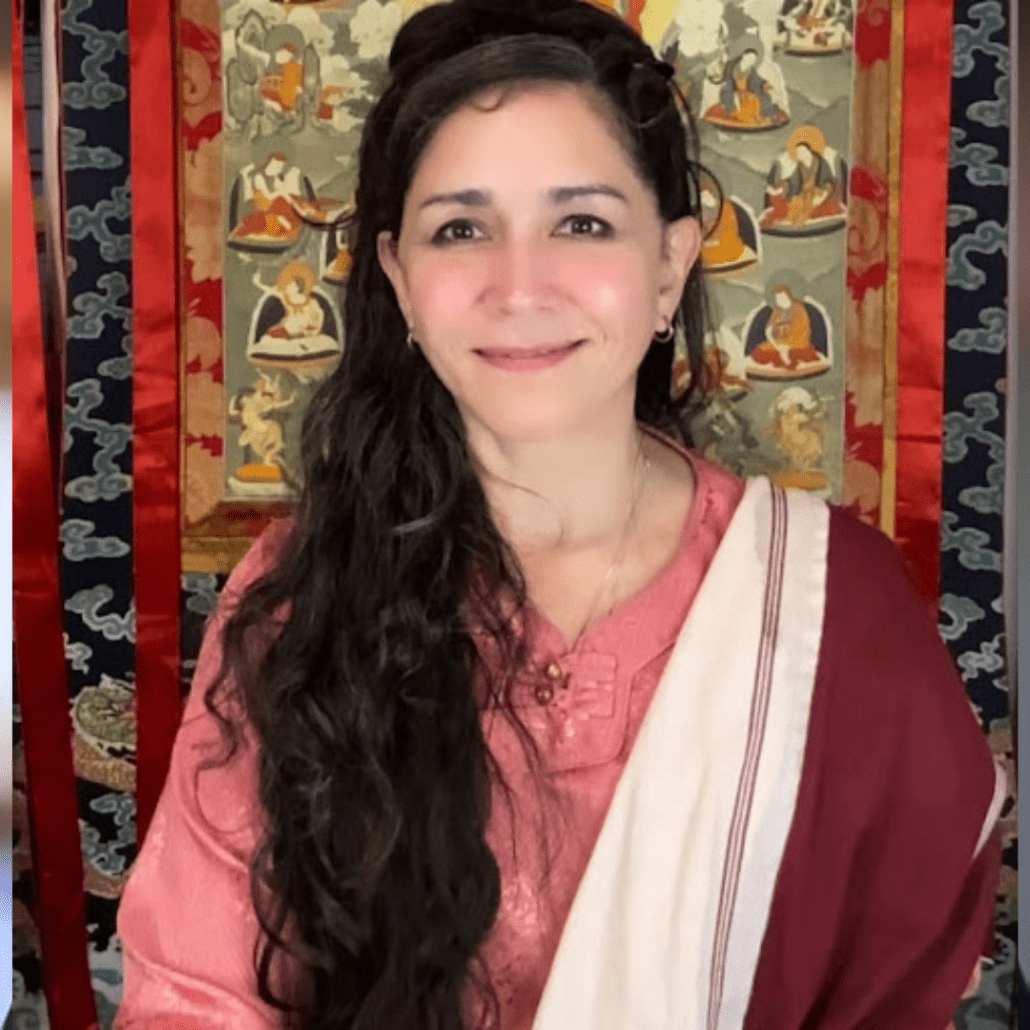
Pema Khandro is a female tulku, and a scholar-practitioner whose work centers on the recovery of women’s contemplative lineages. She holds a PhD in Religious Studies from the University of Virginia, where her research examined the role of female yoginis in fourteenth-century Tibetan Buddhism and she is currently a professor of Buddhist Studies. In particular, her scholarly research examines how Great Perfection (Dzogchen Nyingthig) transformed frameworks for women’s spiritual roles and contemplative practice and documenting the histories of the Great Perfection meditation curriculums. Pema Khandro has also spent her life practicing and teaching as a yoginī and lineage holder in the Nyingma tradition. She is the founder of the Buddhist Studies Institute and was enthroned to carry forward the lineage of Pema Khandro, a Tibetan yogini who taught in the late nineteenth and early twentieth centuries. Her teaching brings together rigorous scholarship and lived practice, framing Buddhist study within its full historical and intercultural context.
Format: Live online via Zoom. Recordings provided for all sessions.
Weekend Retreat: Saturday–Sunday, November 7–8, 2026. 9am-1pm Pacific Time (PT)
Monday Evening Sessions: Mondays, November 9 through November 30, 2026. 5pm-6:30pm PT
Tuition: $450 Standard / $325 Reduced / $650 Sponsor
10-100% Member Discounts: Apply Member Discount Code at Checkout. Learn more about Membership
Includes: Live transmission and practice instructions over two days, four live Monday evening sessions, detailed practice instruction, and recordings for one year.
Tuition
Sliding scale pricing is offered to support broad access. Please choose the rate that aligns with your financial reality, including factors like income, exchange rates, or other life circumstances.
Member Benefits
Members receive 10-100% discounts on standard tuition. Apply your member code at checkout. Learn More about Membership.
Financial Aid
As a non-profit organization, program costs are supported through tuition and donations. For those experiencing extreme financial hardship, limited scholarships may be available for some programs. Assistance must be requested in advance. Financial Scholarship Application
Monastics
Programs are always free for monastics. Monastic Scholarship Application
Which lineage of Lion-Faced Ḍākinī is this?
This is the Longchen Nyingthig lineage, revealed by Jigme Lingpa as a mind treasure. Within the Longchen Nyingthig, Simhamukhā is the wrathful aspect of Yumka Dechen Gyalmo (the Female Practice at the heart of the cycle).
What is an empowerment?
An empowerment (Tibetan: wang) is the formal transmission of a specific practice tradition from teacher to student. Empowerments are the traditional way of entering a deity yoga practice.
Do I need a background in Tibetan Buddhism to attend?
No formal background is required, but completion of 10% ngondro is strongly recommended and is required before intensive training on the 100,000 accumulation of the Lion-Faced Ḍākinī mantra. The oral transmission ceremony will be given with sufficient context that participants can enter the transmission with understanding.
Do I need to have attended the White Tara Program first?
No. This program is complete in itself and open to the public independently. Students who have participated in either or both of the earlier programs will arrive with deeper preparation, but neither is required.
Do I need to attend all three programs in The Yoginī’s Teachings?
No. Each program is complete in itself and open to the public independently.
Are the Monday evening sessions required?
No. Monday evening sessions may be attended live or through recordings, according to your schedule and timezone. All sessions are included with your registration and available for one year.
Will recordings be available?
Yes. All registered participants receive recordings, usually available within 48 hours.
Is financial assistance available?
Yes. BSI offers reduced tuition rates and a limited number of full scholarships for those who need them.
Can I attend in person?
This program is online only, to allow the broadest possible access. BSI hosts in-person retreats usually three times a year — see our calendar for upcoming gatherings.
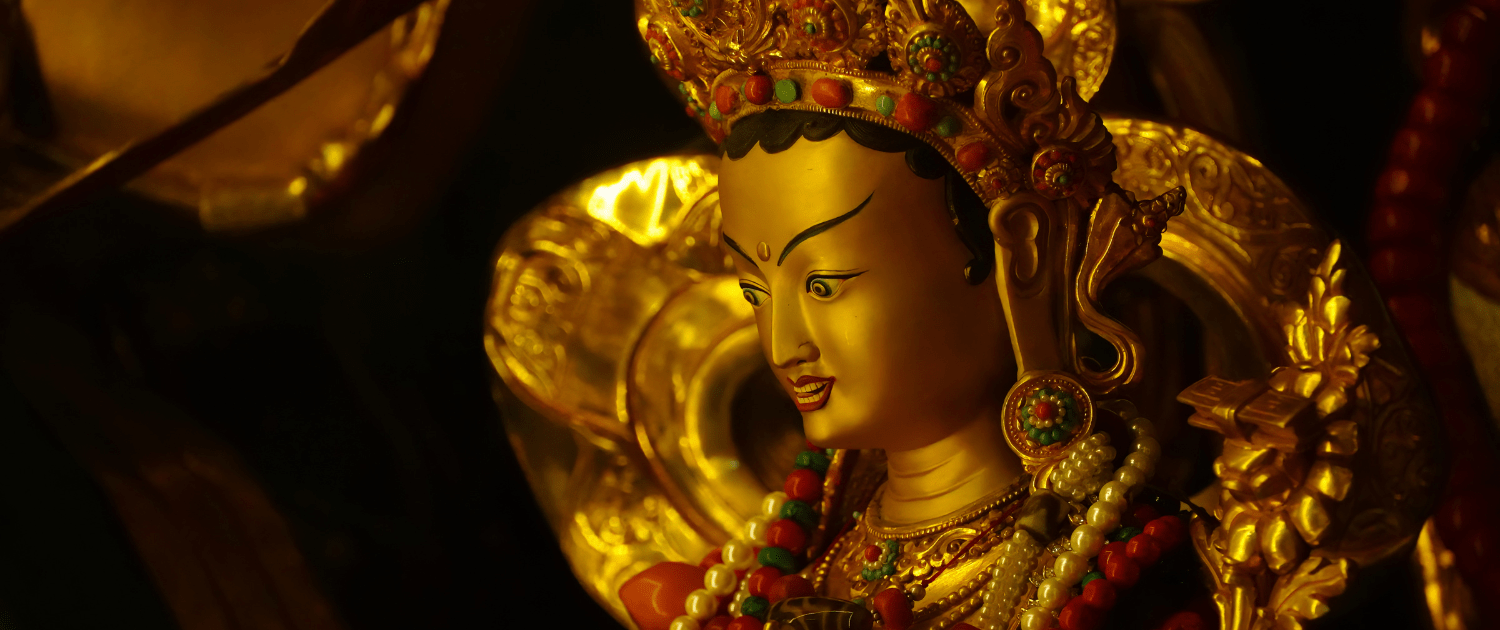
This program is part of the fall teaching theme, The Yoginīs Teachings. These are three standalone programs with Pema Khandro on the three faces of the sacred feminine offered September through November 2026.
The Buddhist Studies Institute is a project of Ngakpa International, a 501(c)(3) nonprofit dedicated to sustaining the householder yogi traditions of Tibet.