Empowerment with Drupon Rinchen Dorjee Rinpoche & Teachings with Tulku Pema Khandro

Online via Zoom
with recordings provided for all sessions
Sat–Sun, October 10–11, 2026
8am – 12pm PT
October 12, 19, 26, and November 2
5pm – 6:30pm PT
Vajrayogini is often called the swift path. Where many deity yoga practices unfold their fruits gradually over years and decades, Vajrayogini’s practice is understood in the tradition to bring realization with unusual directness and speed. This is why the greatest yogins and yoginis of Tibetan history, from Yeshe Tsogyal in the eighth century through the mahasiddhas of India through Machig Labdrön and the treasure revealers of every subsequent century, chose her as their principal yidam. Her practice is for practitioners who have arrived at a moment of readiness and want to enter the tantric path in its most concentrated form.
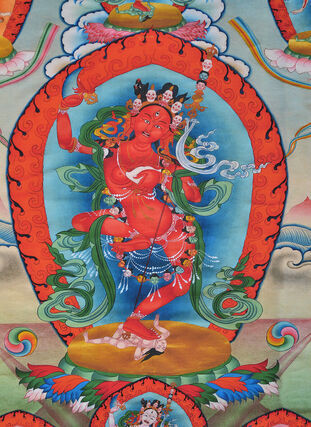
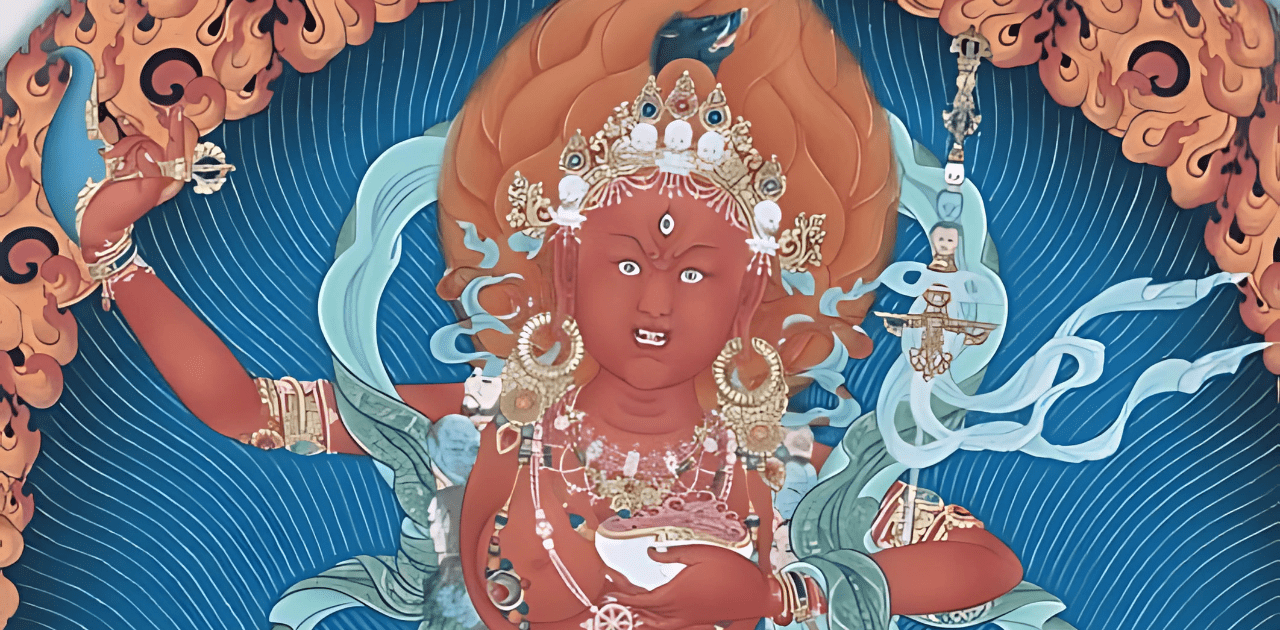
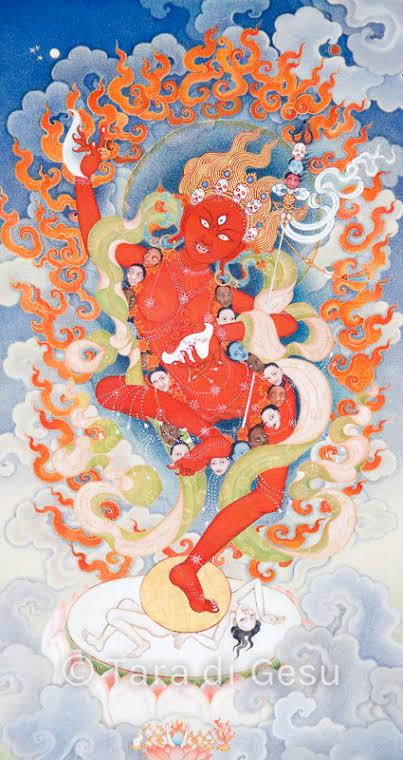
What practitioners describe finding in her practice is difficult to name and unmistakable once encountered. The energies of ordinary life, desire, anger, restlessness, longing, that so often distract or exhaust us, are transmuted in her practice into the fuel of awakening itself. The tradition calls this the wisdom of great bliss (mahasukha), and it is Vajrayogini’s particular gift. Practitioners speak of a growing intimacy with their own awakened nature as her practice matures, of the falling away of the sense that enlightenment is elsewhere or later, and of the direct recognition of the sacred feminine as their own innermost being. Her red body, her curved knife, her skull cup, her posture of dance, these are not distant symbols but a mirror in which practitioners come to recognize themselves.
Her practice offers the traditional benefits of a highest yoga tantra deity: the accumulation of wisdom and merit, the purification of subtle body channels and winds, the swift removal of obstacles to realization, and the sustained protection of the ḍākinīs and dharma protectors of her lineage. It also opens something more specific to her tradition, a direct connection to the ancestral yoginīs and ḍākinīs who carried this practice across twelve hundred years. To take up her practice is to enter a family, with Yeshe Tsogyal, Machig Labdrön, Longchenpa, and Jigme Lingpa as our ancestors. Every yoginī who realized great bliss through this practice, across every generation from the eighth century to the present, becomes our kin. Practitioners describe this ancestral presence as one of the most sustaining and unexpected gifts of the path.
Vajrayogini meditation is engaged in every phase of life. Practitioners take her up at moments of transition and threshold, when the ordinary framework is dissolving and something new is trying to emerge. They engage her practice in times of powerful emotion, when the intensity that would otherwise consume them can be turned toward liberation. This practice is the pre-requisite for the 6 yogas and thus they engage her practice at the end of life, since her sadhana is one of the traditional supports for the transitions of dying, the bardo, and rebirth. And they engage her practice as the daily companion of an ongoing life, the presence that meets them in every mood and every circumstance, the sacred feminine as the closest thing that exists – one’s own intrinsic wisdom.
To receive her empowerment is to be authorized to take up this path. It is also to be brought into the flow of blessings of the lineage: the transmission line that runs from Vajradhara through the mahasiddhas through Yeshe Tsogyal and Padmasambhava through every yogini and yogi who has held this practice, arriving now at you.
The Vajrayogini Empowerment Retreat and Program is a two-day online retreat with the empowerment of Vajrayogini, the wisdom ḍākinī who stands at the heart of the women’s lineage of Tibetan Buddhism. The empowerment is offered jointly by Drupon Rinchen Dorjee Rinpoche, a senior lineage holder in the Tibetan tradition, and Tulku Pema Khandro. It is followed by four Monday evening sessions on the yoginīs of Tibetan Buddhism, taking students into sustained engagement with the tantric heart of the tradition and with Yeshe Tsogyal, whose secret visions of Vajrayogini opened this lineage twelve hundred years ago.
Vajrayogini is the fierce joyful, semi-wrathful face of the sacred feminine. Her lineage was opened by Yeshe Tsogyal’s visions of Vajrayogini in the eighth century and has been transmitted across the centuries through yoginīs, treasure revealers, and generations of practitioners. To receive her empowerment is connect with generations of knowledge on accessing resilient inner wisdom.
In the Longchen Nyingthig lineage as taught by Pema Khandro, Vajrayogini holds a particularly foundational role. She is understood as the sambhogakāya source from which Yumka Dechen Gyalmo, the Queen of Great Bliss and the Female Practice at the heart of the Longchen Nyingthig, manifests. Jigme Lingpa himself wrote in the recitation manual of Yumka: “Since Vajrayoginī is the source of all things and the mother of all the victorious ones, all the maṇḍalas of the various sections of the tantras are complete within her body. By accomplishing her practice, all auspicious interdependent circumstances of the profound and swift path of secret mantra will come together.” The treasure text itself states: “In the expanse of dharmakāya she is Samantabhadrī. In the sambhogakāya realm she is Vajravārāhī, and in the nirmāṇakāya form she is Yeshe Tsogyal.” Vajrayogini/Vajravārāhī is thus the sambhogakāya face of the sacred feminine within the Dzogchen Nyingthig treasure cycle, and to enter her practice is to enter, at the deepest level, the lineage that gives rise to Yumka’s manifold expressions.
October 10–11, 2026
An empowerment (Tibetan: wang) is a direct transmission of a specific practice tradition from teacher to student, given in the context of a ritual ceremony. Saturday is the empowerment itself, offered jointly by Drupon Rinchen Dorjee Rinpoche and with practice instructions by Tulku Pema Khandro, alongside detailed practice instruction. Students will complete the retreat prepared to take up the Vajrayogini practice in ongoing engagement, with a clear framework for the visualization, the mantras, the offerings, and the philosophical understanding that supports the practice. The empowerment gives students a direct connection to the living lineage of which the women’s tradition is a part: not as historical material recovered from the past, but as a tradition that is alive, transmitting now, and available to those who have been moved to enter it.
We begin with the eighth-century yoginī Yeshe Tsogyal, Padmasambhava’s principal disciple, then his teaching partner, then a master in her own right. Beside her, and before her, were two Tibetan princesses who built the first Buddhist temples in Tibet. Yeshe Tsogyal is the one who memorized the teachings Padmasambhava gave. She is the one who wrote down his teachings and concealed many of the treasures. She is the one who, after his departure, continued teaching for decades. In her period of intensive practice, she experienced her secret visions of Vajrayogini, and her journey to final enlightenment followed. Those visions opened the transmission of Vajrayogini practice that has been carried forward by yoginīs, treasure revealers, and generations of practitioners for over twelve hundred years. This session studies Yeshe Tsogyal’s life, her visions of Vajrayogini, and her final testament, given to her disciples before she departed this world.
Vajrayogini is one of the most important deities in all of Tibetan Buddhism. Her iconography, her red body, her curved knife, her skull cup, her posture of dance, is a complete philosophical vocabulary of the sacred feminine. In this session we work with her iconography in detail, the philosophical framework of the wisdom ḍākinī, and the preparation for the empowerment: what students will be receiving, what the transmission means, and what commitments the practice involves. We turn to the lineage of Vajrayogini practice as it has been carried forward from Yeshe Tsogyal in the eighth century, through Pemasel, whose Khandro Nyingthig cycle emerged across her successive rebirths over six hundred years and shaped Longchenpa’s Great Perfection in the fourteenth century, and into the eighteenth century where Jigme Lingpa’s revelation of the Longchen Nyingthig places Vajrayogini at the source of the entire cycle of the sacred feminine.
The Four Monday Evening Sessions:
What is a yoginī? Discover the historical, philosophical, and lineage definitions. Explore the figure of the yoginī in pre-Buddhist Indian context, in early tantric Buddhism, and in the Tibetan reception of these teachings, and contemporary expressions. The Ḍākinī as human teacher, visionary presence, and inner most wisdom mind. This session establishes the framework for everything that follows and introduces the women who made the Tibetan empire: Yeshe Tsogyal, Padmasambhava’s principal disciple and teaching partner, whose visions of Vajrayogini opened the lineage; the two princesses who built the first Buddhist temples in Tibet; and other women whose realization shaped the tradition from its founding.
Of all the major Tibetan Buddhist lineages, exactly one was founded by a woman. Her name was Machig Labdrön, she was an eleventh-century yoginī, and the practice she created, chöd, “cutting through,” became so powerful that all four schools of Tibetan Buddhism adopted it. It is still practiced widely today, both by monastics inside monasteries and in the yogic tradition, outside in wild places. The story of Machig has been told many times, however behind Machig’s lineage stands the wrathful wisdom of Troma Ngamo, the Black Ḍākinī, a yoginī tradition that has been awakening contemplative power for over a thousand years. This week we study selections from the Black Ḍākinī’s Secret Tantra, and hear Pema Khandro’s own account of meeting a living Ḍākinī in this lineage.
Discover the lives and teachings of female treasure-revealers, including Sera Khandro, Khandro Tare Lhamo, and others who carried forward the visionary tradition of Tibetan Buddhism into the modern era. Explore the phenomenon of the tertön, or treasure-revealer, one of the most distinctive contributions of Tibetan religious life. Contemplate selections from Sera Khandro’s autobiographical writings alongside material from Khandro Tare Lhamo’s correspondence with her partner Namtrul Rinpoche during the Cultural Revolution. Within this tradition, women have held a particular and powerful role.
Throughout Tibetan Buddhist history, much of women’s documented religious life, particularly in tantric contexts, has been organized around the role of the consort. This week examines that history carefully and honestly, in its profound complexity. We will engage deeply with the historical material: what consort practice actually was and is in Tibetan tantra, the distinction between karmamudrā and jñānamudrā, the ethical structures the tradition itself articulated around the practice, and the great consort partnerships that shaped lineages, from Yeshe Tsogyal and Padmasambhava through the consorts of the mahāsiddhas to the partnerships of modern treasure revealers. We then turn to the contemporary reckoning: the well-documented cases of teacher-student boundary violations in contemporary Buddhism, the responses of various sanghas and lineages, and the ongoing conversation about ethics in contemporary tantric communities. We close with discussion of how contemporary practitioners can engage this tradition ethically.
The two-day live Vajrayogini Empowerment Retreat with Drupon Rinchen Dorjee Rinpoche and Tulku Pema Khandro. Four live Monday evening sessions on the teachings of the yoginīs of Tibetan Buddhism with Pema Khandro, opening with Yeshe Tsogyal and the women at the origins of the lineage. Access to over two dozen self-paced video teachings on Vajrayogini drawn from Pema Khandro’s classes over the past two years. Recordings of all live sessions, available to watch for up to one year. Students from any timezone may participate fully through live sessions or recordings. Primary source readings translated for the program. Access to a private cohort discussion forum.
Registration also includes over eighteen self-paced video teachings of extremely detailed Vajrayogini practice instruction, drawn from Tulku Pema Khandro’s ongoing Vajrayogini course over the past two years. These recordings go deeper into the visualization, the mantras, the offerings, the philosophical framework, and the day-to-day rhythm of the practice than any weekend can. Students carry them as a library of instruction to return to over years of practice, watching sections again as their understanding deepens and specific questions arise. Nothing comparable is available in the online Vajrayana world.
This program is open to all who wish to receive the empowerment of Vajrayogini. There are no formal prerequisites, though ngondro is recommended and before engaging in the ongoing accumulation of Vajrayogini mantras, whereby students should have completed at least 10% of ngondro. Students should come with sincere interest in the tradition and readiness to receive the transmission.
It will be of particular interest to:
All sessions are recorded and available for one year. Students from any timezone are welcome and may participate live or through recordings.
Drupon Rinchen Dorjee Rinpoche is a senior lineage holder in the Tibetan Buddhist tradition and daily practitioner of Vajrayogini and has been teaching annually at the Buddhist Studies Institute since 2020. Drupon Rinpoche received teachings on the Fivefold Path of Mahamudra and Kunsang Lama’s Words of Profound Instruction, Dzogchen’s Great Completion Parting from Samsara and Nirvana, Pointing Out the Nature of Mind, and other teachings from Tulku Nyendrak Gyaltsen Rinpoche. Rinpoche has also received Chakrasamvara according to Drilbupa, including the empowerment, scriptural transmission, and pith instructions from Tulku Thogme Rinpoche. Drupon Rinchen Dorjee has received instruction in philosophy, Gongchig, Theckchen Tenying, Dhagpo Thargyan, and Uttaratantra from Khenchen Konchog Gyaltsen and other profound teachers of the Lineage.
In 1995 Drupon received full ordination vows from His Holiness Drikung Kyabgon Chetsang Rinpoche, and in the same year accomplished the ngondro practices to mahamudra and the grand mantra recitation of Chakrasamvara. In 1996, he received initiation into the Profound Path of the Six Yogas of Naropa. Drupon Rinchen Dorjee Rinpoche has completed two (2) three-year retreat courses, one at Almora and one at Labchi, the holy retreat place of the great yogi, Milarepa. He has received profound instructions too numerous to mention during these retreats. In 2005, he received the five-deities Hevajra according to Marpa’s tradition of empowerment, transmission and instructions from His Holiness the Drikung Kyabgon Chetsang Rinpoche, and in 2006 he completed the grand mantra recitation of glorious Hevajra’s fire puja at the Almora retreat center.
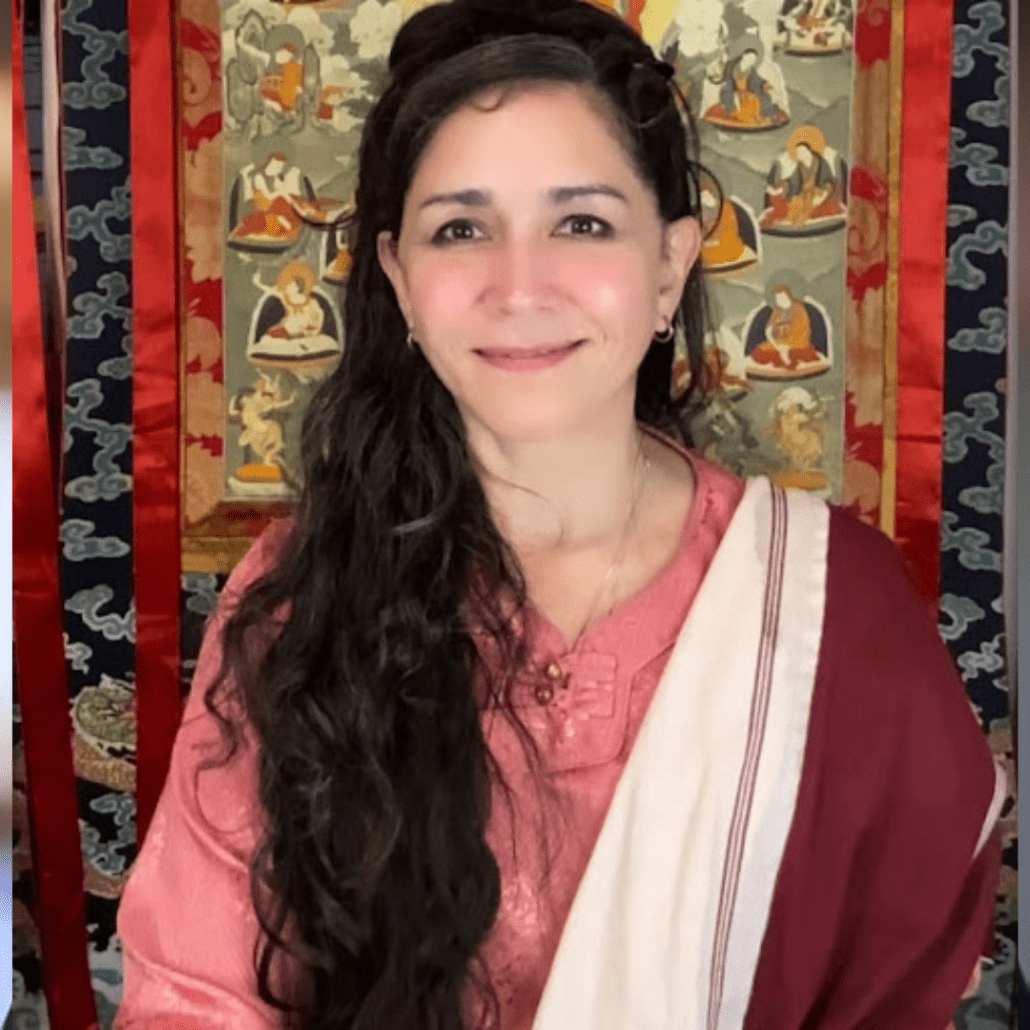
Pema Khandro is a female tulku, and a scholar-practitioner whose work centers on the recovery of women’s contemplative lineages. She holds a PhD in Religious Studies from the University of Virginia, where her research examined the role of female yoginis in fourteenth-century Tibetan Buddhism and she is currently a professor of Buddhist Studies. In particular, her scholarly research examines how Great Perfection (Dzogchen Nyingthig) transformed frameworks for women’s spiritual roles and contemplative practice and documenting the histories of the Great Perfection meditation curriculums. Pema Khandro has also spent her life practicing and teaching as a yoginī and lineage holder in the Nyingma tradition. She is the founder of the Buddhist Studies Institute and was enthroned to carry forward the lineage of Pema Khandro, a Tibetan yogini who taught in the late nineteenth and early twentieth centuries. Her teaching brings together rigorous scholarship and lived practice, framing Buddhist study within its full historical and intercultural context.
Format: Live online via Zoom. Recordings provided for all sessions.
Weekend Retreat: Saturday–Sunday, October 10-11, 2026. 8am-12pm Pacific Time (PT)
Monday Evening Sessions: Mondays, October 12 through November 2, 2026. 5:00 – 6:30pm Pacific Time (PT)
Tuition: $450 Standard / $325 Reduced / $650 Sponsor
10-100% Member Discounts: Apply Member Discount Code at Checkout
Includes: Live empowerment ceremony over two days, four live Monday evening sessions, detailed practice instruction, recordings for one year, and access to over two dozen self-paced video teachings on Vajrayogini.
Tuition
Sliding scale pricing is offered to support broad access. Please choose the rate that aligns with your financial reality, including factors like income, exchange rates, or other life circumstances.
Member Benefits
Members receive 10-100% discounts on standard tuition. Apply your member code at checkout. Learn More about Membership.
Financial Aid
As a non-profit organization, program costs are supported through tuition and donations. For those experiencing extreme financial hardship, limited scholarships may be available for some programs. Assistance must be requested in advance. Financial Scholarship Application
Monastics
Programs are always free for monastics. Monastic Scholarship Application
Do I need a background in Tibetan Buddhism to attend?
No formal background is required. Ngondro is recommended and students complete at least 10% of ngondro before beginning the journey of daily accumulation of the 100,000 Vajrayogini mantras. The empowerment ceremony will be given with sufficient context that participants can enter the transmission with understanding so that they can practice Vajrayogini when they are ready. For those that need it, Ngondro is offered annually through the Buddhist Studies Institute starting in late January or early February.
Do I need to have attended the White Tara Program first?
No. This program is complete in itself and open to the public independently.
Do I need to attend all three programs in The Yoginī’s Teachings?
No. Each program is complete in itself and open to the public independently.
Do I need to attend the Lion Faced Ḍākinī Retreat after this program?
No. This program is a complete offering in itself.
Are the Monday evening sessions required?
No. Monday evening sessions may be attended live or through recordings, according to your schedule and timezone. All sessions are included with your registration and available for one year.
Will recordings be available?
Yes. All registered participants receive recordings, usually available within 48 hours.
Is financial assistance available?
Yes. BSI offers reduced tuition rates and a limited number of full scholarships for those who need them.
Can I attend in person?
This program is online only, to allow the broadest possible access. BSI hosts in-person retreats usually three times a year — see our calendar for upcoming gatherings.
This program is part of the fall teaching theme, The Yoginīs Teachings. These are three standalone programs with Pema Khandro on the three faces of the sacred feminine offered September through November 2026.
The Buddhist Studies Institute is a project of Ngakpa International, a 501(c)(3) nonprofit dedicated to sustaining the householder yogi traditions of Tibet.