Program One of The Yogini’s Teachings
Online
Online with Pema Khandro via Zoom
with recordings provided for all sessions

Online with Pema Khandro via Zoom
with recordings provided for all sessions
Sat–Sun, September 12–13, 2026
9am-1pm PT
September 14, 21, 28, and October 5
6:30pm – 8:00pm PT
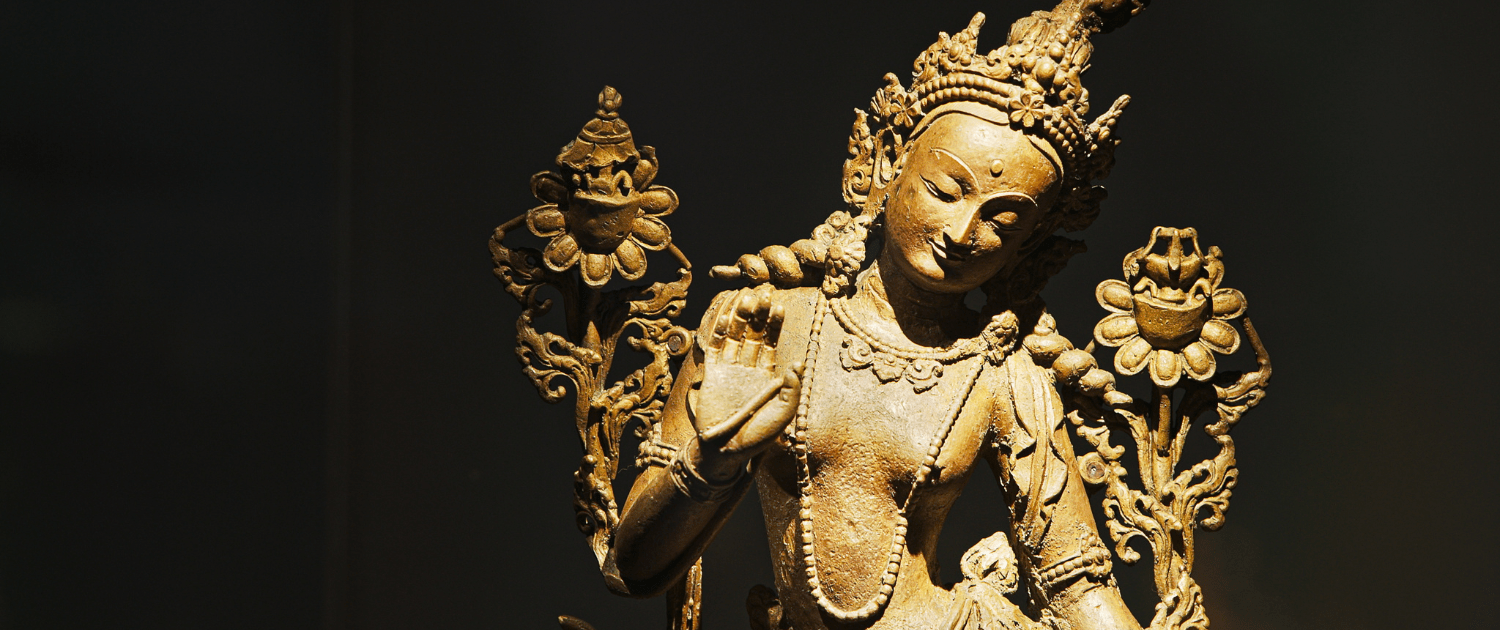
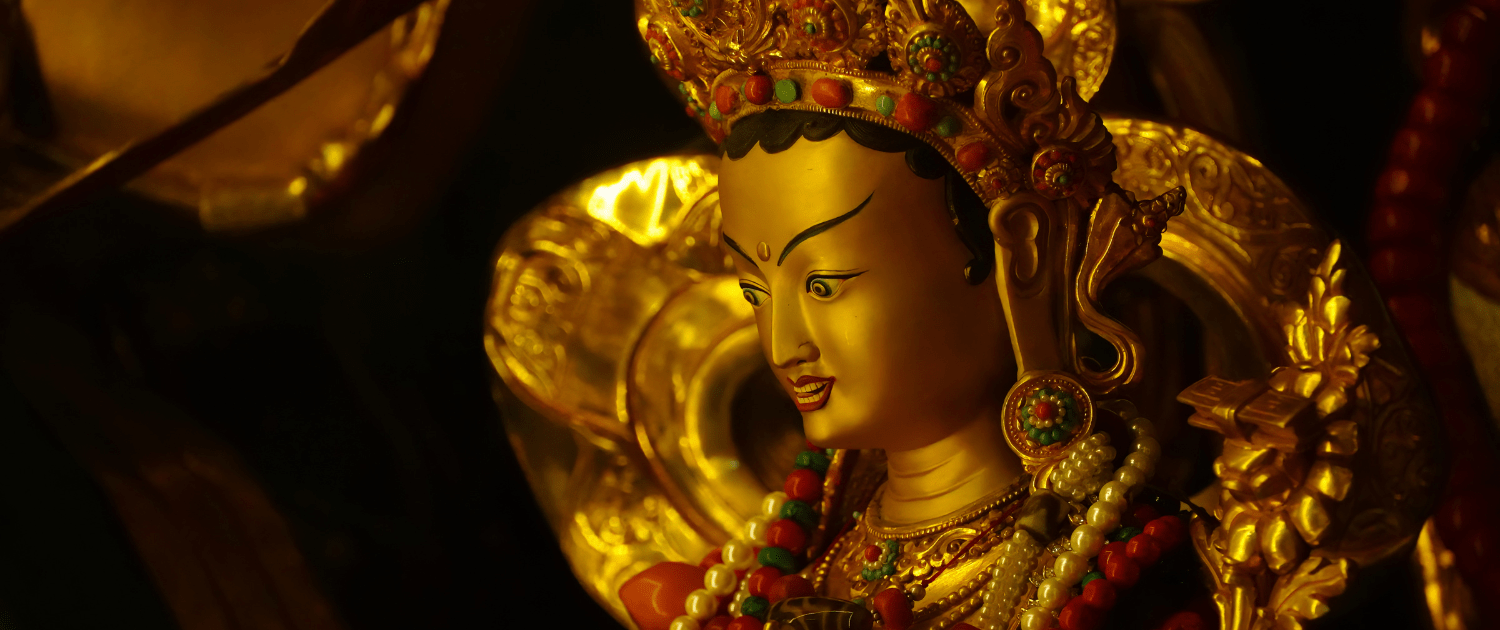
White Tara is one of the most beloved figures in Tibetan Buddhism. She is the peaceful sacred feminine of long life, healing compassion, and the wisdom that sustains practice across a lifetime. Her mantra is recited in monasteries and homes across the Himalayas, and her image, seated in the diamond posture with seven eyes of wisdom looking in all directions, is one of the most enduring representations of the sacred feminine in the entire Buddhist tradition.
For over a thousand years, White Tara has been the yidam of long life practice (Tibetan: tshe sgrub) across the Himalayas. Her practice is engaged when illness arises, when obstacles threaten life, when a beloved teacher or family member is aging or sick, and simply in the ongoing cultivation of the conditions that allow one to complete a full and meaningful life. The tradition holds that her mantra, recited with faith, extends the lifespan, restores the depleted life-force, and averts untimely death, giving the practitioner more time to practice, to serve others, and to reach the goals of the path.
The benefits reported in the tradition are wide. Healing of body and mind. Recovery from illness for oneself and for others one holds in prayer. Protection from the fears and obstacles that arise in any life. Peace of mind in the presence of the stresses that shorten life. The steady accumulation of merit and wisdom over the duration of a life of practice. And, most distinctively, the qualities suggested by her very name: the Wish-Fulfilling Wheel (Yishin Khorlo). Her practice is thought to fulfill the wishes of the practitioner, understood in the tradition to include both the worldly wishes for health, longevity, and the flourishing of those we love, and the deeper wishes for wisdom, insight, and awakening.

Because her practice is fundamentally about sustaining the conditions of a long and meaningful life, it is also the foundation for every other practice a student may undertake. Long life is the ground of dharma practice: without it, no other practice can be completed. This is why White Tara is invoked at the beginning of major undertakings, at moments of transition, and continuously throughout the life of a serious practitioner. Renowned for clearing obstacles to health she is also practiced for the long life of one’s teachers, so that the lineage may continue, and for the long life of loved ones and family members, so that the bonds of care may endure. In her practice, compassion is enacted not only for oneself but for the whole web of relationships in which a practitioner lives.
In the Longchen Nyingthig revealed by Jigme Lingpa in the eighteenth century, White Tara appears as the Wish-Fulfilling Wheel practice (Drolkar Yishin Khorlo), a sādhana composed by Jigme Lingpa himself drawing on three transmission streams: the long kama lineage of Atisha’s tradition, the close terma lineage of Chöjé Lingpa (1682–1720), and, most profoundly, Jigme Lingpa’s own direct visionary blessing received from Tara herself. Tara is also the peaceful face of the sacred feminine within the wider Yumka Dechen Gyalmo cycle, the Queen of Great Bliss, whose Female Practice sits at the heart of the whole Longchen Nyingthig. This weekend enters White Tara through this lineage.
This program begins with a two-day retreat introducing White Tara: her origin story, her lineage of transmission from Atisha through the early masters into the Nyingma tradition and Jigme Lingpa’s visionary revelation, the philosophy of long life practice in Vajrayana, and the transmission of her mantra as an ongoing practice students can carry forward. It continues with four Monday evening practice sessions with a turn to the sutra-level foundations of the sacred feminine in Mahayana Buddhism: the stories of the great women teachers of the Mahayana sutras, the personification of wisdom itself as the Mother of All Buddhas, and the living legacy of women’s practice from the earliest sangha to the present day.
The White Tara Program is the opening event of The Yoginī’s Teachings with Tulku Pema Khandro: three standalone programs on the three faces of the sacred feminine, all drawn from the Longchen Nyingthig lineage. It is complete in itself, standing on its own for those who wish to receive the White Tara transmission and the Mahayana women’s teachings. It is also an ideal entry point to the tantric and Dzogchen programs that follow, for those who wish to continue.
September 12–13, 2026
We begin with White Tara herself. The origin story of Tara from Tāranātha’s Origin of the Tārā Tantra: Princess Yeshe Dawa, Wisdom Moon, and her vow to always take rebirth in a woman’s body until all beings are freed, made in response to a monk who told her she should pray to be reborn as a man to make faster progress. We will explore the spiritual weight of that vow: the willingness to enter into a form least expected on the path to awakening and a female buddha who chose femaleness as the vehicle of enlightenment rather than the obstacle to it. The distinct role of White Tara within the wider Tara family, her association with long life practice, and the lineage of her transmission from Atisha through the early masters, through Chöjé Lingpa’s terma revelation, and through Jigme Lingpa’s own direct visionary blessing from Tara herself, which composed the Longchen Nyingthig White Tara Wish-Fulfilling Wheel practice we take up in this program.
Saturday’s second session turns from history to practice. We introduce the philosophy of long life practice (tshe sgrub) in the Vajrayana tradition: what it means to practice for long life, why practitioners across the Himalayas have carried this practice for over a thousand years, and how it relates to the deeper Vajrayana teachings on subtle body, life-force energy, and the accumulation of merit. The session closes with transmission of the White Tara mantra and detailed practice instruction appropriate for both new and experienced practitioners, with no prior commitments required.
Sunday continues the White Tara meditation practice tradition. We work with the White Tara sadhana in detail: the visualization, the mantra, the seven eyes of wisdom, and the meaning of each element of her iconography. We attend to the philosophical framework of White Tara as the peaceful sacred feminine, understood within the tantric grammar of the five wisdom families and the wider tradition of the sacred feminine, and specifically within the Longchen Nyingthig’s own framework where she appears alongside Yumka Dechen Gyalmo. The day includes discussion of how to carry the practice forward in daily life and how it can be integrated with other practices students may already hold.
The Four Monday Evening Sessions
Trace the living legacy of women’s practice back to its earliest roots. The Therīgāthā, the poems of the awakened nuns, preserved and honored across the traditions and one of the earliest bodies of women’s spiritual poetry in world literature. Mahāprajāpatī and the founding of the nuns’ order as the ancestral moment of women’s institutional Buddhist practice. The great female arhats of the early sangha, whose realization the tradition itself recognized as equal to that of their male contemporaries. This session opens the Monday arc by grounding it in the historical women from whose practice everything that follows in the Mahayana and Vajrayana traditions ultimately grew.
Engage deeply with the perfection of wisdom personified as feminine. The foundational Mahayana teaching that wisdom (feminine) and skillful means (masculine) together produce buddhahood, which means enlightenment itself has a feminine mother. Prajñāpāramitā as she appears in the sutras from the Aṣṭasāhasrikā onward, her iconography, and her relationship to Tara as the compassionate activity that arises from her wisdom.
Meet the great women teachers of the Mahayana sutras. Queen Śrīmālā delivering the Tathāgatagarbha teaching in the Śrīmālādevī Sūtra. The unnamed Goddess of the Vimalakīrti Sūtra who bests Śāriputra in dharma dialogue and refuses to change her body from female to male when he challenges her. The Nāga Princess of the Lotus Sutra who attains buddhahood on the spot at eight years old. Sudhana’s female teachers in the Gaṇḍavyūha Sutra, including Vasumitrā the courtesan, Māyādevī the Buddha’s mother, and the night goddesses. What these narrative choices reveal about how Mahayana thought treated female teaching authority.
Return to Tara at the close of the Monday arc, now with the wider family in view. Explore Green Tara as the primary activity aspect who protects from the eight great fears, White Tara’s distinct role as the peaceful yidam of long life, and the Twenty-One Taras as the full spectrum of Tara’s emanations from peaceful through semi-wrathful to wrathful. Engage with the Praise to the Twenty-One Taras, the foundational Tara text recited daily across the Himalayas. Consider how a single figure of the sacred feminine manifests across a full range of activities and moods, and how this internal structure of the Tara family previews the peaceful, semi-wrathful, and wrathful arc that runs across the all the programs of the Yoginī’s Teachings through Vajrayogini and Simhamukhā.

This program is open to everyone. No prior background in Buddhism is required, and the material will be presented in a way that is genuinely accessible to newcomers while offering depth for experienced practitioners.
It will be of particular interest to practitioners drawn to Tara practice; students of Tibetan Buddhism wanting to receive White Tara transmission specifically from within the Longchen Nyingthig lineage; lamas, scholars, and researchers in religion, women’s studies, or Buddhist literature; contemplatives interested in the sutra-level foundations of the sacred feminine; chaplains, therapists, and healers drawn to peaceful compassion practices; and anyone called to the peaceful face of the sacred feminine.
All sessions are recorded and available for one year. Students from any timezone are welcome and may participate live or through recordings.
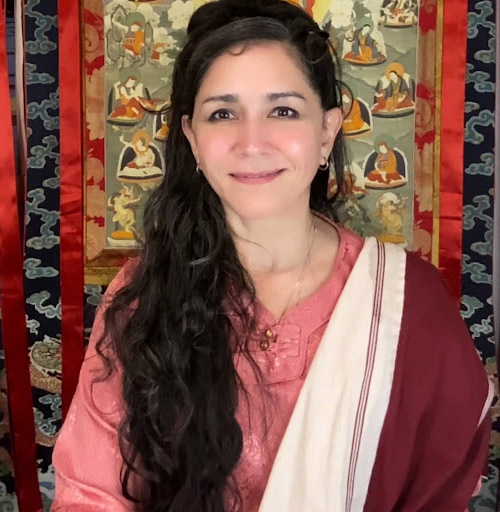
Tulku Pema Khandro, Ph.D.
Tulku Pema Khandro, Ph.D
Authorized Lama, Lineage Holder, and Scholar
Pema Khandro is a female tulku, and a scholar-practitioner whose work centers on the recovery of women’s contemplative lineages. She holds a PhD in Religious Studies from the University of Virginia, where her dissertation examined the role of female yoginis in fourteenth-century Tibetan Buddhism and she is currently a professor of Buddhist Studies. In particular, her scholarly research examines how Great Perfection (Dzogchen Nyingthig) transformed frameworks for women’s spiritual roles and contemplative practice and documented the histories of the Great Perfection meditation curriculums. Pema Khandro has also spent her life practicing and teaching as a yoginī and lineage holder in the Nyingma tradition. She is the founder of the Buddhist Studies Institute and was enthroned to carry forward the lineage of Pema Khandro, a Tibetan yogini who taught in the late nineteenth and early twentieth centuries. Her teaching brings together rigorous scholarship and lived practice, framing Buddhist study within its full historical and intercultural context.

Aruna Rigdzin Ross was ordained in the Nyingma lineage by Pema Khandro Rinpoche in 2007 and has since dedicated her life to the study, practice, and transmission of Buddhist wisdom. She serves as a Director of Ngakpa International, is the Chief Financial Officer of the Buddhist Studies Institute, and also leads as Director of the Yogic Medicine Institute, where she integrates ancient wisdom traditions with modern approaches to healing and well-being. A NAMA-certified Ayurvedic Practitioner with more than two decades of experience as an advanced yoga and meditation instructor, Aruna is deeply respected for the clarity, compassion, and presence she brings to her work. Her teachings and client care reflect a passionate commitment to holistic healing, sustainable living, and the empowerment of individuals to cultivate health, balance, and joy in their lives.

Satya Shiva, a White Tara practitioner, has been a devoted student of Pema Khandro Rinpoche and the Vajrayana since 2001 and has served as Faculty, Programming Director, and board member of the Buddhist Studies Institute since 2010. She is also the Clinic Director of the Yogic Medicine Institute, where she has guided integrative healing programs and worldwide retreats since 2004. A Doctor of Acupuncture and Oriental Medicine, as well as a NAMA-certified Ayurvedic Practitioner and Panchakarma Specialist, Satya is the founder of Radiance Healthcare and Clinical Director at Dakini Mountain Retreat. Her leadership reflects a lifelong dedication to Eastern medicine, integrative healing, contemplative practice, and compassionate care, guiding people toward radiant health, clarity, and vitality.
Format: Live online via Zoom. Recordings provided for all sessions.
Weekend Retreat: Saturday–Sunday, September 12–13, 2026. 9am-1pm Pacific Time (PT)
Monday Evening Sessions: Mondays, September 14 through October 5, 2026. 6:30-8pm Pacific Time (PT)
Tuition: $325 Standard / $225 Reduced / $650 Sponsor
10-100% Member Discounts: Apply Member Discount Code at Checkout
Includes: All live sessions, recordings for one year, transmission and practice instruction.
Tuition
Sliding scale pricing is offered to support broad access. Please choose the rate that aligns with your financial reality, including factors like income, exchange rates, or other life circumstances.
Member Benefits
Members receive 10-100% discounts on standard tuition. Apply your member code at checkout. Learn More about Membership.
Financial Aid
As a non-profit organization, program costs are supported through tuition and donations. For those experiencing extreme financial hardship, limited scholarships may be available for some programs. Assistance must be requested in advance. Financial Scholarship Application
Monastics
Programs are always free for monastics. Monastic Scholarship Application
Do I need a background in Tibetan Buddhism to attend?
No. The weekend and the evening sessions are designed to be accessible to those new to the tradition, while offering depth for longtime practitioners.
Will there be a transmission or empowerment?
The Saturday and Sunday sessions include the transmission (lung) of the White Tara mantra and detailed practice instruction.
Which lineage of White Tara is this?
This is the White Tara Wish-Fulfilling Wheel (Drolkar Yishin Khorlo) from the Longchen Nyingthig, composed by Jigme Lingpa from his direct visionary blessing received from Tara herself.
Are the Monday evening sessions required?
No. Monday evening sessions may be attended live or through recordings, according to your schedule and timezone. All sessions are included with your registration.
Will recordings be available?
Yes. All registered participants receive recordings, usually available within 48 hours of each session, for one year. Students from any timezone may participate live or through recordings.
Do I need to attend all three programs in The Yoginī’s Teachings?
No. Each program is complete in itself and open to the public independently.
Can I attend in person?
This program is online only, to allow the broadest possible access. BSI hosts in-person retreats usually three times a year — see our calendar for upcoming gatherings.
Is financial assistance available?
Yes. BSI offers reduced tuition rates and a limited number of full scholarships for those who need them.
This program is part of the fall teaching theme, The Yoginīs Teachings. These are three standalone programs with Pema Khandro on the three faces of the sacred feminine offered September through November 2026.
The Buddhist Studies Institute is a project of Ngakpa International, a 501(c)(3) nonprofit dedicated to sustaining the householder yogi traditions of Tibet.